Professor Yang
 Know more>>
Professor
Department of Chemical Biology, Xiamen University
Know more>>
Professor
Department of Chemical Biology, Xiamen University
Contact Information
Yang's LaboratoryRoom 532, Lujiaxi Building, College of Chemistry and Chemical Engineering, Xiamen University, Xiamen 361005, China
Ph: +86 (0) 592-218 7601cyyang@xmu.edu.cn
Yanli Gong's paper accepted by ACS Nano
2025-07-23 21:46:00

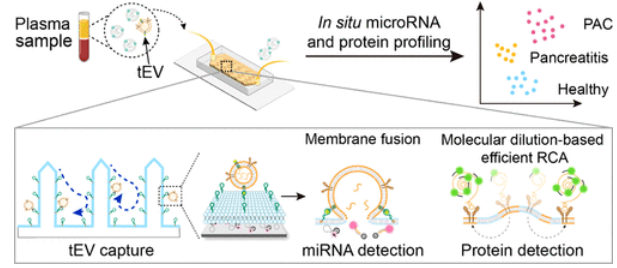
Co-profiling of microRNAs (miRNAs) and membrane proteins of tumor-derived extracellular vesicles (tEVs) is crucial for accurate tumor diagnosis. However, it is hindered by the low abundance of tEVs and the challenge of simultaneous signal transformation from internal and surface markers due to the membrane barrier. Here, we engineered a fluid nanoforest interface (FluidforestFace) within a microfluidic chip by coating supported lipid bilayers (SLBs) on nanoforest substrates, enabling the efficient capture of tEVs and in situ profiling of tEV miRNAs and surface proteins. FluidforestFace offered a large surface area and generated nanovortices with localized low velocities, facilitating the efficient capture of tEVs (∼86.8%). Upon membrane fusion, tEV miRNAs diffused into probe-encapsulated substrates for in situ detection. Meanwhile, tEV membrane proteins were diluted onto SLBs to avoid molecular crowding, which allowed efficient signal amplification reactions for sensitive protein detection using a readily accessible wide-field fluorescence microscope. By codetecting three important miRNA and membrane protein markers, FluidforestFace achieved high diagnostic accuracy for pancreatic cancer patients (n = 38) compared to healthy individuals (n = 12, ∼98.9%) and pancreatitis patients (n = 13, ∼92.9%), indicating its potential for clinical applications.