Professor Yang
 Know more>>
Professor
Department of Chemical Biology, Xiamen University
Know more>>
Professor
Department of Chemical Biology, Xiamen University
Contact Information
Yang's LaboratoryRoom 532, Lujiaxi Building, College of Chemistry and Chemical Engineering, Xiamen University, Xiamen 361005, China
Ph: +86 (0) 592-218 7601cyyang@xmu.edu.cn
Xiyuan Yu's paper accepted by J Am Chem Soc
2026-05-29 15:06:33

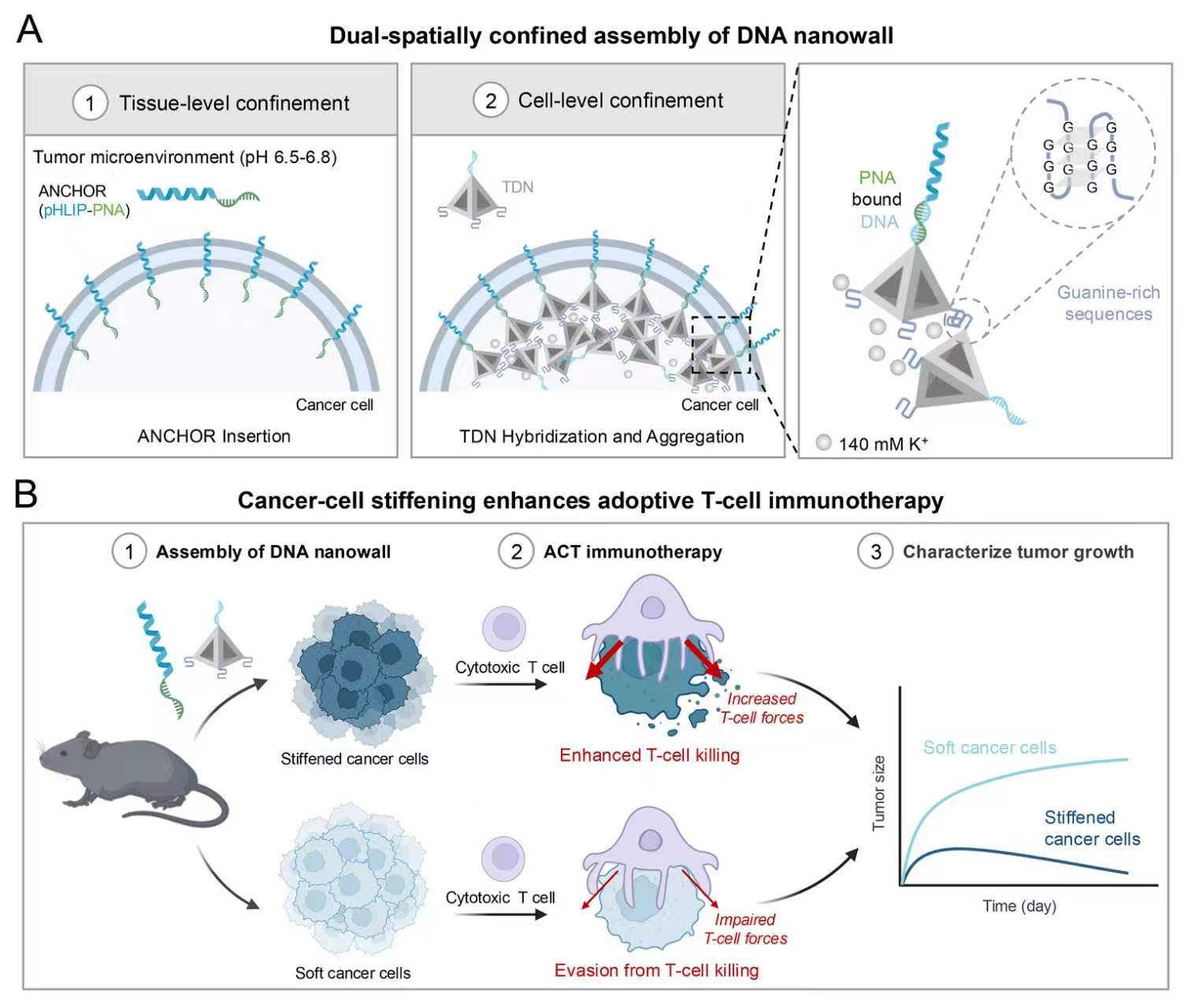
Cellular softness acts as a mechanical immune checkpoint, suppressing T-cell mechanosensing and cytotoxici-ty to drive tumor immune evasion. However, existing approaches to modulate membrane stiffness lack specificity, limiting targeted therapeutic potential. Here, we report a dual-spatially confined DNA nanowall assembly strategy to enhance tumor cell stiffness, thereby augmenting the efficacy of adoptive T-cell immunotherapy. In acidic tumor microenvironments, low pH-triggered membrane-anchored probes (tissue-level confinement) selectively guide the construction of a DNA nanowall on the inner leaflet of the tumor cell membrane (cellular-level confinement). This biomechanical reprogramming markedly ele-vates tumor rigidity. When combined with adoptive T-cell transfer (ACT) immunotherapy, this strategy restores T-cell me-chanical force generation capacity, significantly improving tumor-killing outcomes in vitro and in murine solid tumor mod-els. Our findings underscore the critical role of biophysical signals in cancer-immune interactions, demonstrating that target-ing mechanical immune checkpoints can potentiate antitumor immunity. Furthermore, these discoveries bridge biophysics and oncology, offering a paradigm for precision cancer therapy through spatiotemporal control of cellular mechanics.