Professor Yang
 Know more>>
Professor
Department of Chemical Biology, Xiamen University
Know more>>
Professor
Department of Chemical Biology, Xiamen University
Contact Information
Yang's LaboratoryRoom 532, Lujiaxi Building, College of Chemistry and Chemical Engineering, Xiamen University, Xiamen 361005, China
Ph: +86 (0) 592-218 7601cyyang@xmu.edu.cn
Chenling Ding's paper accepted by Anal Chem
2026-07-07 20:03:51

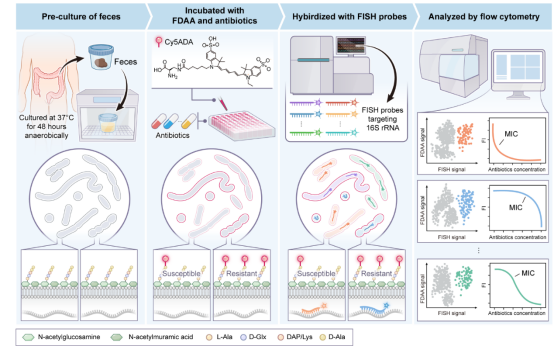
Knowledge of the susceptibility of gut bacteria to antibiotics is important for understanding the frequent gut mi-crobiota dysbiosis caused by oral antibiotic administration. However, traditional antimicrobial susceptibility testing (AST) methods are not applicable to unculturable microbes that account for most gut bacteria. Furthermore, they are inapplicable to assess bacterial responses to drugs within a complex microbial community such as the gut microbiota. Here we developed CommAST (Community-level Omni-species Metabolic-activity Antibiotic Susceptibility Testing), a platform profiling multi-species antibiotic susceptibility within complex microbial ecosystems. By treating a microbiota sample with serial concentra-tions of antibiotics and labeling it with fluorescent D-amino acids, the metabolic status of individual bacterial cells is then quantified by flow cytometry, while their species identity is determined simultaneously via fluorescence in situ hybridization (FISH). CommAST can thus simultaneously determine the minimum inhibitory concentrations for multiple species within a microbial system. When applied to human fecal microbiota, CommAST profiled MICs for 105 drug-bacteria combinations across 27 species. A substantial portion of these were previously uncultured taxa, thereby providing the first antibiotic sus-ceptibility profiles for these species. Notably, we uncovered significant discrepancies between strain-level and community-level MICs, with community-level MICs frequently exceeding their strain-level counterparts. Transcriptomic analysis revealed that enhanced community tolerance stems from synergistic mechanisms, including biofilm protection, metabolic cost-sharing, and coordinated stress responses. Collectively, CommAST establishes an innovative community-level AST platform, enabling a deeper understanding of the mechanisms behind antibiotic-induced gut dysbiosis.